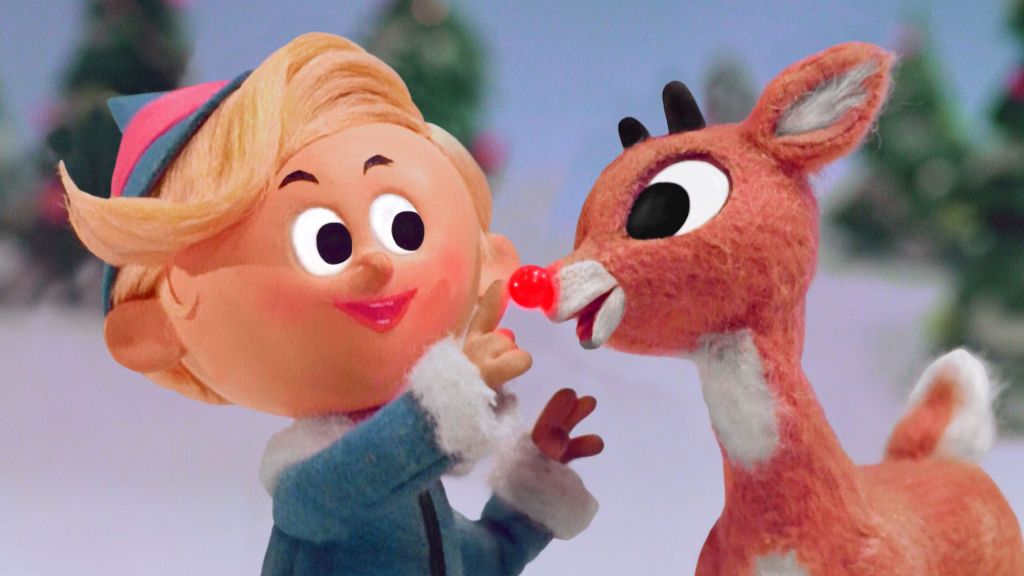
As I sit by the fire with snow falling outside my window, I know that today is a special day in Christmas TV history. Rudolph the Red-Nosed Reindeer premiered on NBC December 6, 1964. Sixty years later, Rudolph, Clarice, and the Island of Misfit Toys are still pop culture treasures. I am grateful that the Rankin-Bass stop-motion stories have transcended generations. Memories of growing up with them in the ’90s and 2000s are still fresh, whether I was watching Rudolph and friends on VHS or on the 25 Days of Christmas.
I’m thrilled to share my conversation with a fellow TV historian, Herbie J Pilato, who loves Rudolph as much as I do. Pilato is the author of a new holiday book titled Christmas TV Memories: Nostalgic Holiday Favorites of the Small Screen. His book One Tough Dame: The Life and Career of Diana Rigg also debuted this year. Pilato is an actor and a prolific author with valuable insights on pop culture history. I love that his work highlights powerful female icons in entertainment and that he is a wealth of classic TV knowledge. “I did something productive with my obsession,” Pilato tells me. Below, we chat about Rudolph, Charlie Brown, Bewitched, Christmas TV movies, and more. You can peruse Herbie J Pilato’s work and learn more about him on his website.
This interview has been edited and condensed for length.

AM: In addition to your Christmas TV Memories book, you have a new book out about Diana Rigg, you’ve been a longtime historian of Elizabeth Montgomery and Bewitched, so I was wondering if you have always been drawn to the lives and careers of actors.
HJP: I’m going to say yes to that. It started really with Elizabeth Montgomery and Bewitched, and I grew up in the 1960s. It was littered with Vietnam War, the drug issues, the race rioting, the assassinations, the political mayhem. It was just a mess. We were all looking for some kind of escape, as entertainment usually serves that purpose in all areas, and it has since the beginning of time. But TV was relatively new, and all of the shows on during the 1960s were fantasy-based or sci-fi based, most of them were, or they were fantasy families that didn’t really exist.
I grew up in the inner city of Rochester, New York. It was a tough neighborhood. I got beat up a lot. I was cute, you know, so all the bullies beat me up because I had all the little girls after me. So it was good and bad. I was drawn to TV shows like Bewitched and specifically Elizabeth Montgomery, Samantha. She could have anything she wanted. She could have any guy she wanted. She loved Darrin for who he was, and that really affected me. Subconsciously as a kid, but definitely as an adult, I started to see there was a lot more going on with the show besides magic. It was not just a silly little show. It was a love story, and they had the strong work ethic of Darrin and the angle of prejudice. So Bewitched began it all for me regarding TV.
I wanted to be an actor originally. I had studied acting my whole life and got to LA and worked as an NBC page. And that’s where I sort of got interested in behind-the-scenes stuff. They did a reunion movie for I Dream of Jeannie, NBC did in 1985, called I Dream of Jeannie: 15 Years Later. That upset me because I Dream of Jeannie was like a ripoff of Bewitched. That’s just the way it is. It was this hot blonde, magical woman in love with this dark-haired mortal guy, and it was the same thing. So I thought, Well, if they’re gonna do a reunion about that kind of story… then we should do a reunion about Bewitched. I wrote one. Elizabeth Montgomery didn’t want to do it. And that’s when the first book came along and then all the other books after that.
AM: I am so interested right now in the connections between Bewitched and I Dream of Jeannie, and shows in the last 20 or so years dealing with magic and that extraordinary quality a lot of these characters have. Can you talk to me a little bit more about how important it is for a show that’s built on a fantasy premise to have something undergirding that that allows us to connect with these characters on a deeper level?
HJP: Well, it’s very, very important to first have a good story and have whatever happens in that world make sense within that world. I mean, the one thing about Bewitched is yes, it was illogical, but there was a logic within the illogic. Samantha put a spell on somebody, only Samantha could take it off. Couldn’t be Endora. There were rules that they abided by in that realm. The show to me was not a show about a witch. It was about a person who happened to be a woman who happened to be a witch, which is why I think it just was so popular in the ’60s, across the board, to all minorities. They sensed her sense of isolation. And yet Elizabeth played it so realistically from her heart that she made witches likable and believable because she was likable and believable in that role. Whether it’s a fantasy or whether it’s more grounded, just make it make sense because the audience isn’t stupid.
AM: To turn to a different kind of magic, Christmas magic, I’m going to start with some of our animated friends here. Christmas TV can become all-encompassing, as with Charlie Brown and Peanuts, especially when the story and the characters and the music together evoke warmth and nostalgia for us every year. So in your new book, you discuss Linus telling the Christmas story. What is it about that moment specifically that still resonates with you?
HJP: Charlie Brown was so frustrated with the commercialism of Christmas and yada, yada, yada, and Linus gets up there and he goes, “Charlie Brown, I can tell you what Christmas is all about. Lights, please.” Here he is talking about Jesus being born, on a cartoon in 1965 on mainstream TV. You probably couldn’t do that today. That show would not get done or get produced the way it did, today. So that struck me, and I grew up Catholic, and let me be clear about this book and about my other Christmas book, The 12 Best Secrets of Christmas.
Christmas, it’s not just for Catholics and Christians. It’s for everybody. What it represents is unconditional love for each other. I grew up with all cultures in my neighborhood and throughout my life. My parents taught me always to respect people for who they were, and that was it. It didn’t matter what they look like. And certainly I have faced prejudice as an Italian American, too, at times, and stereotypes and all of that. But I was raised in a beautiful family who happened to be Italian American, just like Samantha happened to be a witch. I just happen to be Italian American. It doesn’t define me. I think my humanity defines me. So that’s the message that I tried to get across with both the 12 Best Secrets of Christmas and certainly Christmas TV Memories. And the great thing about Christmas carols is that really, most of the great ones were written by people who happen to be Jewish. So there you go.
AM: Well, one of the things that connects you and I is a love of Rudolph, and I’m so excited for the 60th anniversary. I love that you’ve written about what it was like to grow up with Rudolph in the ’60s as he was depicted in the Rankin-Bass special. He was one of the first Christmas characters I knew and loved in my early years in the ’90s. So what do you think it is about Rudolph and Clarice and all of these characters that gives them such appeal across generations?

HJP: My attraction to that special is very similar to what it was with Bewitched. Again, I was picked on, and I felt like I could identify with Rudolph. He had a red nose, and I was a short kid, so that was it, and then seeing him and Clarice fall in love, which is the romance of it all. The Island of Misfit Toys where the toys come alive. They’re not toys. They’re things that happen to be toys that happen to have feelings. They’re not defined by being toys. I love that one line and I mentioned it in my book: [King Moonracer] says, “A toy is truly not happy unless it is loved by a child.” I mean, come on, that has to be one of the greatest Christmas TV special lines of all time.
The charm of Rudolph was that it was made like it was made. And it took forever because they make one little move, then they take a camera shot, then they move the little dowels again and take another shot. Some things don’t need to be changed or remade and Rudolph is one of them.
AM: Well, you might relate to this. I feel that nostalgia is a very meta thing for me and that I can look back on different times of my life and see where I was being nostalgic. I remember as a teenager knowing the connection I had with Rankin-Bass and the VHS tapes, or watching it on 25 Days of Christmas. I would just stay up at night reading things written by Rick Goldschmidt, whom you cite, and learning more and more about the history of it all.
I could talk about Rankin-Bass for hours. But to connect that with another important topic in your book, holiday made-for-TV Movies are a staple for so many people. You take us back in time to show that these Christmas movies of the week predate the launch of the Hallmark Channel or Lifetime. So what have been some of your favorite TV Christmas TV movies from the broadcast networks in history to research more deeply?
HJP: I would have a top three. First of all, Marlo Thomas, who wrote the foreword to my book (she wrote a beautiful foreword, icon of That Girl, ’60s TV, ‘Free to be you and me,’ an author herself), she did a TV movie in 1977 called It Happened One Christmas, which was the TV remake of It’s a Wonderful Life before it became It’s a Wonderful Life, the phenomenon that it is today. Back then, people really didn’t know, of the modern age, about that film since it was released in the ’40s. So it started getting repeated a little bit after It Happened One Christmas, Marlo’s remake. I remember watching Marlo’s remake and not knowing about the original and saying to myself, Boy, this is a really good story. Well, it’s a really great story because Frank Capra first did it in the ’40s and he was a genius.

Number two, The House Without a Christmas Tree, which was made in ’72 and aired on CBS. It’s this sweet little story with no budget. It was videotaped like they used to do soap operas. But oh my gosh, Jason Robards and Lisa Lucas, who I interviewed for this book, and Mildred Natwick. Just this sweet little story based in the 1940s about this young woman who wants a Christmas tree, which her father has refused to give her. I’m not going to say why, because I don’t want to ruin it for everybody. If you haven’t seen it, you need to watch it. If you’re parents, you need to have your children watch it. So by the end of the episode, we understand why he never wanted a Christmas tree in the house. And it’s just so beautifully, beautifully told. I absolutely love it. Like I said, I grew up Catholic, so I went to Catholic schools. That cloakroom that they use in that one school scene where little Lisa’s character, Addie, she gets into a fight with this boy, the cloakroom just reminded me so much of my old school back in New York. So that was also personal.
Then the third movie that I love is Father Knows Best: Home for Christmas. Father Knows Best was a 1950s TV family sitcom. That movie was a reunion movie of those characters starring Robert Young and Jane Wyatt and Elinor Donahue, who I interviewed for the book. It was again, low-budgeted, videotaped, but the story and the charm was there. The original show was filmed like a half-hour film. I never saw it as a sitcom. I saw it as a drama with comedic overtones. I was introduced to Father Knows Best because of that movie. I was too young to know the original series. I started watching it because of that movie.
AM: Do you have either a favorite Christmas episode or even a favorite trope that reoccurs in some of the holiday episodes through the years?
HJP: Well, everybody, of course, remakes their own Christmas Carol.
AM: Exactly. I was thinking about this today.
HJP: First of all, there’s like 90 million TV movie versions of A Christmas Carol. And there’s also several feature film Christmas Carols. But episodes or shows like The Odd Couple, Bewitched, Six Million Dollar Man, they all did Christmas Carol redos. The Six Million Dollar Man featured Dick Sargent, who was the second Darrin on Bewitched, and Ray [Walston], star of My Favorite Martian. So you had two different fantasy series stars now playing different characters in a science-fiction Christmas Carol remake.
Bewitched did several great episodes. One was the Christmas Carol remake. The other was “Sisters at Heart,” which was a story that was written by the 1971 graduating class of Jefferson High in Los Angeles.
The producers found out about how much this class loved the show. And they wrote this episode that was polished by Barbara Avedon, who would later on do Cagney and Lacey, the drama detective series. It was about Tabitha befriending this young girl who happened to be Black. They went to the park, and they were made fun of because they wanted to be sisters. And a bully says, you can’t be sisters because you don’t look alike. So Tabitha tries to make them look alike with “Wishcraft,” not witchcraft, but “Wishcraft.” And she ends up having black polka dots on her, white polka dots on the African-American girl. They have to call Dr. Bombay to ease the situation and cure them. But the great message was, Samantha says it at the end, “Tabitha, you don’t have to look alike to be sisters. All men are brothers, even if they’re girls.” It was just another great line. So that is an amazing episode. It also was Elizabeth Montgomery’s favorite episode.

AM: I’m thinking, too, about the ways that we encounter these specials, whether that’s for you, seeing some of them in real time or learning about a show like Father Knows Best through the TV movie. For me, watching reruns. It’s so different today. We have Christmas episodes and movies on demand. We have for quite some time. So I’ve been thinking about this. On the plus side, that dose of nostalgia is a click away if the show you love is streaming. But that’s a totally different feeling from the 25 Days of Christmas in its heyday and just encountering these things on cable, or network showings of Rudolph. So what’s your preferred method of holiday viewing in such an established streaming climate now?
HJP: Wow. I mean, when we only had three networks back in the ’60s and ’70s, and one TV per household, it was destination viewing. It was something special. Oh, Rudolph is going to be on tonight. We gotta make sure we have dinner and finish the dishes and watch the news, but then sit down and not be disturbed. It would be an event. TV shows were an event. Today, just flipping on your phone or going on YouTube and finding Rudolph while everybody else is doing their own thing and in their own rooms with their own phones and their own YouTubes, it’s not the same. I would encourage everyone, number one, to sit down and have dinner as a family every night and to shut off the phones. Number two, to gather in the living room like you would going to a movie theater and make it event programming.
AM: I would love to hear what you might have coming up. I know you’re always working on something or digging into new research.
HJP: Yes, I’m working on a special book, very different than anything I’ve done before in that it’s not really media-related. The 12 Best Secrets of Christmas, that was my memoir, so that was unique, too, from my media titles. But this one’s very different. It’s going to be out in April.
Thank you to Herbie J Pilato for taking the time to chat about classic Christmas TV with me, and for celebrating our dear Rudolph’s 60th anniversary! You can find Herbie J Pilato on social media @herbiejpilato, and check out a Rudolph-focused excerpt from Christmas TV Memories over on his Substack!
 Past Foot Forward