
Writer and social media producer Jonathan Hurwitz (he/they) has me laughing at the beginning of our interview, when they momentarily sound like a mad scientist plotting a juicy TikTok series. But that’s actually not what Jonathan had in mind when he let Lizzie McGuire fans in on a few secrets in January.
An accomplished storyteller in the entertainment industry, Jonathan intimately knows the complexities of writing great television. His work on the Disney Channel series Andi Mack will touch your heart in a way you probably haven’t felt since Lizzie kissed Gordo’s cheek at the end of junior high, or since Devon stood outside Raven’s window playing Blue Rain from his boombox. Jonathan also wrote the entire 2019 Disney Channel short-form series Shook, starring Sofia Wylie as a teen facing obstacles on the path to pursuing her dance dreams. Jonathan then wrote episodes of the adorable Disney Junior show Spidey and His Amazing Friends.
Nestled between these projects was Jonathan’s role as a staff writer on the Lizzie McGuire reboot meant for Disney+. Years after the project’s disappointing demise—filming two episodes which were never released, as executives eventually canceled the more adult series—Jonathan has posted videos about working in the writer’s room, sculpting a grown-up Lizzie.
Throughout our interview, Jonathan discusses mental health in ways both enlightening and accessible. They note that one reason we still lean into nostalgia could be a desire, heightened during a global pandemic, “to consume pieces of culture that felt safe and comfortable and familiar.” Jonathan continues, “New can be scary, so let’s wrap ourselves in the warm hug of familiar shows and movies.”
Pop culture has long been a source of comfort for Jonathan, and I believe many of us can relate. The Disney Channel of the 2000s told us to watch Lizzie and “get inside her head.” What an honor to get inside her writer’s head and learn more about Jonathan’s life and work. Enjoy my conversation with Jonathan Hurwitz! This interview has been edited for length and includes discussion of mental health.
Allison: The response to your Lizzie TikToks has been beautiful within the fandom, and then it became part of the celebrity news cycle. So, in the words of Hilary Duff, “Let’s go back, back to the beginning.” How did you initially decide to discuss the Lizzie McGuire reboot so openly on TikTok?
Jonathan: I feel like there’s a part of the story missing, ’cause I wasn’t just sitting here in my room thinking, “Ooh, what am I going to do today?” That’s not how it happened. I’d been only recently starting to post on TikTok, like, videos of myself. Now, mind you, for the last few years, I had been working in social media marketing, helping brands make TikToks, but I was not posting myself. So this was relatively new, and I had been posting about my struggle to find a job over the last year. Someone commented on one of my job hunt videos and said, “Can you do a video about the jobs that you’ve had before?” So I decided to do one about the last job that I was truly excited about, which was [the Lizzie McGuire reboot]. My intention was not to reveal dark secrets or come from a place of negativity or spite. It sounds cheesy, but [I] really just wanted to come from a place of joy and celebration. I loved working on this show that was so dear to me as a kid, so I just wanted to share some of the joy I experienced while working on it. [Lizzie] was such a beloved character, and we were so excited when the reboot got announced, so it just felt like we deserved to get a little closure around it all.
Allison: Do you feel like you found that closure as you got some of these Lizzie memories out of your head and into the world?
Jonathan: I do. There’s a lot of power in being able to connect with virtual strangers, I guess you could call them. I had no idea how passionate the fanbase was until I started posting these videos. Actually, I got a really sweet DM … I feel like it kind of sums up my experience: He basically said that Lizzie got him through his tween years as an in-the closet queer kid, so it was beyond thrilling to him, to hear that Lizzie might come back into our lives as an adult who’s going through what we’re going through now. I completely relate to that, and that really just spoke to me. I was 11 when the show started and 14 when it ended. So it’s those really really scary, weird tween years when everything is sort of high-stakes and exciting and confusing. Lizzie perfectly captured that stage of life and just felt incredibly relatable then and, I firmly believe, would feel relatable today to everybody who grew up with her.
Allison: We needed her. But to hear you talk about what could have been and what you all worked so hard on, I think brought closure to a lot of us, too, which is awesome. Lizzie is a special character. I know it was a big deal for fans to hear your co-worker Suzanne Weber discuss a pivotal scene from the Lizzie reboot. What do you think it would have done for viewers to actually see Lizzie interact on-screen with the animated character who was historically represented as some semblance of her psyche?
Jonathan: It wasn’t until we were in the room that I was really reminded that in the original series, live-action Lizzie, Hilary Duff, never shares a frame with animated Lizzie. We cut to animated Lizzie commenting on whatever she’s going through. And completely separate from animated Lizzie, when [the reboot writers were] in the room talking about the season and how we could portray an authentic journey for a 30-year-old woman navigating the world, we couldn’t not talk about mental health. I was one of many writers in the room who were sharing their personal journeys with anxiety and the inner critic. Through those conversations, we were able to make a connection between our own mental health journeys and animated Lizzie, who really is that inner critic. I mean, it’s something that felt so relatable to me in watching the show. I would not have been able to articulate it as an 11-year-old, but animated Lizzie so perfectly captured that experience of having this whole internal life that might differ or conflict with your external life and how other people perceive you.
I feel like it’s the first episode of the original season where Lizzie wants to be a cheerleader. She is this very smart and strong and independent girl, and, at the same time, wants the sparkle and attention of being a cheerleader. That, to me, is so real and relatable, and you could be both of those things. We wanted to show her now, as an adult, still kind of navigating that gap between internal and external life.
Allison: It’s interesting, sometimes I feel like the older I get, the more memories I have from really formative times of being a little kid or a teenager, these little snapshots. Maybe part of that is because I deal with nostalgia a lot. You have written for pretty much every age group at this point, in your work in entertainment. Do you ever feel like that has pulled you back toward memories of being your younger self and things that were really monumental in your own life? Or does that translate differently when you’re trying to create a world for a different character?
Jonathan: I’ve written for preschool, Andi Mack was middle school, Shook was high school, Lizzie was going to be a young adult, she was turning 30. So in a really beautiful way, being in these writers rooms has allowed me to, I would say, reconnect with my inner child. As I’m getting older and just talking to my friends who are getting older with me, we all have very interesting, different relationships to our inner child. I think, as adults, it’s very easy to forget that that inner child exists, but I think it’s so important to reconnect with whoever that person is. I did a very LA thing… I did a session with [an energy healer for the first time], and it was intense. I had a panic attack in the room, and she helped me through it, and we got through it, and we did a debrief that was an hour.
She had me do this exercise, and she said, “This is going to feel weird and cheesy, but I want you to look at that pillow next to you and think of that pillow as your anxiety.”
I said, “Okay.”
She said, “Name him.”
And I named him Peter, and there was a whole reason behind that. I had a conversation with him, and I basically said, “Hey, little dude, you’ve been with me my whole life. You’re no longer serving me. I need you to take a step back here. I’m in the driver’s seat now. You cannot control me.”
It’s taken me 34 years to get there. That is kind of the journey that we were going to have Lizzie go on. So the end of season one would have been the first time that she really acknowledges the voice, and then you would have seen, in later seasons, her really exploring her ever-evolving relationship with that inner voice.
Allison: From the beginning of a pandemic to the end of this huge Lizzie project to the WGA and SAG-AFTRA strikes is something I can’t imagine going through from your perspective. So what has helped you on the hardest days or passages of your career?
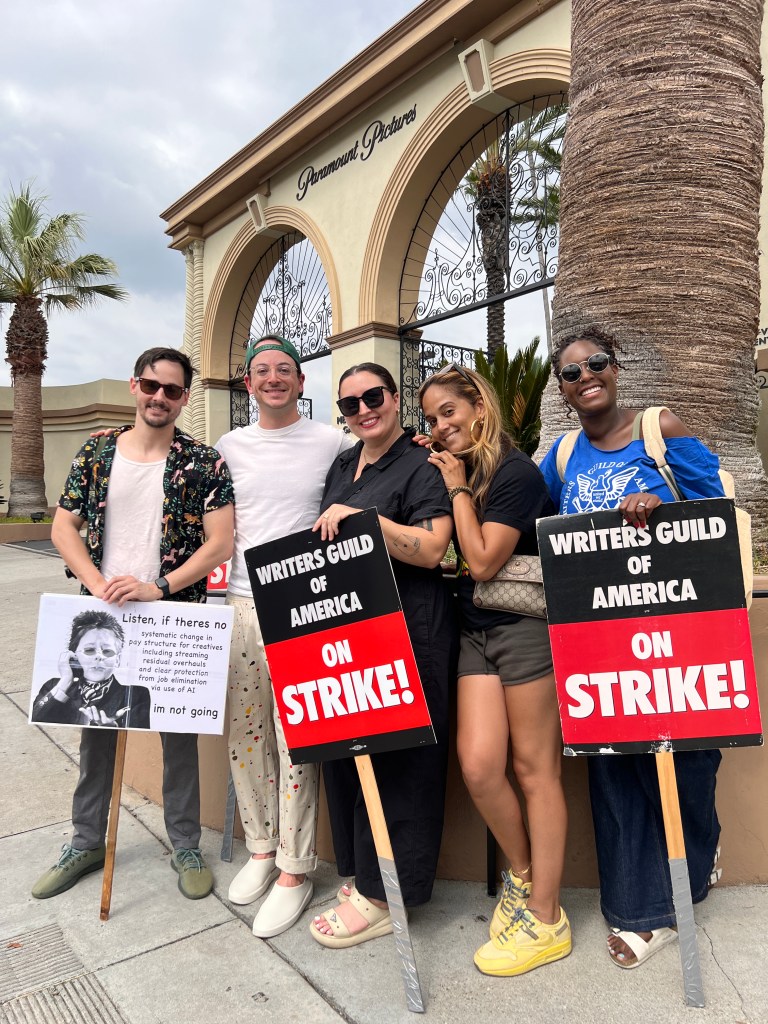
Jonathan: The last four years have been really tough. [In my mental health journey], how do I navigate the anxiety and depression that I’ve felt over the last few years, when you work so hard to get to a certain place career-wise? I felt so lucky. I had my dream job. I was writing on Lizzie McGuire, and it’s everything that I wanted to do. Then the rug was pulled from under me, so I found myself leaning into two different things: Therapy has been immensely helpful to me, and I would like to post a little bit more about mental health on my TikTok and plan on doing videos about it. Therapy, I think, is an incredible resource. Unfortunately, it costs money. It’s expensive, and so, when you’re struggling financially, it can be tough to afford therapy. So there are beautiful resources out there. This is specific to people in LA, but worth mentioning. The LGBT center here in LA offers 16 sessions for a reduced cost, depending on your insurance and how much you’re making. I just finished session 16 last week. So there are mental health resources out there, even if money is an issue. I just feel like it’s important to put that out there.
The other thing that I really leaned into, and this sounds so obvious and basic, is family. I went home, and I feel lucky to have a home to go back to, but I spent six, seven months at home in my Olivia Rodrigo long-sleeve t-shirt. This is my anxiety sloth back here, his name is Santa, and you can put him in the microwave, and he warms up and smells like lavender, and it’s like a weighted blanket on your chest. So going home, being in my childhood bedroom–speaking of the inner child–being in my childhood bedroom with my anxiety sloth, listening to Taylor Swift and Beyoncé and Olivia Rodrigo, that’s how I got through. I leaned into culture, which is what I’ve been doing since I was a kid.
Allison: I remember when you were on the hunt for Britney Spears’ memoir and how big of a day that was for you, how important it was for you to secure that. So I’d love to hear more about how her work, specifically, has impacted your life and artistic career.
Jonathan: I posted a video [featuring] a screenshot of this Vanity Fair article from 2018. I love it. Richard Lawson wrote it, and he talks about how young queer people spend so much time looking through culture, trying “to find the gay stuff,” as he calls it. And when you find it, it becomes holy, like, it becomes religious. Britney Spears was the first cultural icon who felt holy to me. In spite of what I told my friends, I did not want to date her. I wanted to be her. Britney hit me in 1998 when “…Baby One More Time” came out. So I was nine. And then Destiny’s Child came into my life in 1999, so when I was ten.
As a kid, I was uncomfortable in almost every space, especially public spaces. School was really hard for me. But if I could just get home and go in my room and shut my door and put on Britney and Beyoncé, I knew I was going to be okay. They truly fueled my soul and kept me alive. As most artists do, they grow up, and they evolve. I grew up and evolved, too, right alongside them. As decades go by, I think that emotional tie becomes stronger and stronger between myself and these cultural icons. After 20+ years of having these people in my life, getting to read Britney’s memoir or see Beyoncé’s Renaissance Tour, they are deeply, deeply emotional experiences for me. They aren’t just books or concerts, they are holy, spiritual experiences.
Allison: That is so good. I know you lived in London and San Francisco. I want to hear more about your time working in a Bay Area pie shop, and I’d love to know what places you’ve been to in the world that have most inspired you.
Jonathan: I spent most of my life in a small town in Maryland. Let’s start there. Leaving my town to go to college in Michigan… that felt massive for me. I spent my first two years of school at University of Michigan in Ann Arbor and loved it, but in starting college and going through freshman, sophomore year, as I was thinking about the future, I always wanted to work in entertainment, but just didn’t know how to do that. Could that actually be a possibility? I was surrounded by people who were going to be lawyers, doctors, etc. So my first big step was transferring schools. I went to NYU for junior and senior year.
I was a junior at NYU in film school, sitting in my first film class, and I was listening to the girls behind me compare their favorite cafes in Paris. And I remember thinking, “Oh my God, people have been to Paris. Like, what? I’ve only been to New York.” So living in New York is when my world started to open up.
I studied abroad in London in 2011, and it changed my life. Now, I had just come out to the majority of people in my life weeks before I went. So that trip was incredibly significant and meaningful for me. I was out for the first time and literally went out to a gay club for the first time. My friends took me. It was my first weekend in London. I walked in and Rihanna was playing, and they grabbed my hand and took me on the stage, and we were dancing. It was such a huge moment for me. I love theatre, so I wanted to see a show. We saw James Corden in One Man, Two Guvnors. I was sitting in the front row. … At one point, the spotlight landed on me, and James got off stage and told me to get out of my seat. I thought he was kidding; he wasn’t. He took my seat and pointed to the stage and told me to get onstage in front of thousands of people and take his spot. So I was literally in the spotlight—as somebody with anxiety, that is my biggest nightmare—and I panicked. I, to this day, do not know why, but I did a cartwheel. I felt like screaming and running away. I did a cartwheel. I did gymnastics when I was younger. I guess it was still there. It was still in my bones [laughs]. Looking back, it felt significant to me because I’d been kind of a silent passenger most of my life. That London trip was kind of the first time that I was able to become more of a driver and realize that I had agency and could be myself, and it’s okay to express what I wanted to do.
It feels natural that I moved to San Francisco right after to work at Pixar, which was my dream company. I saw Toy Story when I was ten and fell in love with animation. It just put this world on screen that I feel like I had already imagined in my head… All those years later, as an adult, I got to work there and it was incredible.
I realized, to grow, I was going to need to leave. I ended up leaving for a job at Google, and it wasn’t the right place for me. …I was there for about six months and I left, not sure of what I wanted to do. Almost every day, I would get off work from Google and would walk home and stop at this pie shop and get a piece of lemon pie. It was my happy place. After I quit, I walked in and said, “Are you hiring?” I got a job there. It was such a much-needed job to have a break from the industry of it all. I was there for about six months and then I ended up getting a job in LA, and that’s when I moved to LA. That was ten years ago.
Allison: That is so cool. You’ve lived so many different lives. I love it.
Jonathan: Yeah… I have. I think your value in a writer’s room is, who are you and what lived experiences are you going to bring to the room? So the more experiences that I have, the more value I am in a room. I know people who want to be writers who have spent the majority of their life in their room writing scripts. I think that on one hand, that’s great to get the practice in, but I always want to encourage people: Go out into this wild world and live and do things and mess up and have fun and go move to another country, go speed dating (which I am tomorrow), go do things, because then you’re going to have things to write about.
Allison: One of the things I wanted to talk about was actually value in writing. Everything you’re saying, I’m sort of relating to on a different level in journalism. It can be hard to remember that my worth and abilities aren’t attached to what’s in my inbox in terms of replies or commissions. Sometimes it’s hard to place work that we believe in.
Jonathan: I have seen various therapists over the last decade, and one of them was an art therapist, and she had me do this exercise early on in my work with her, where she had me draw a pie chart and had me fill in who I am, what makes up me. Like 90% of my pie was career, work. 10%, friends and family. We talked about that in the weeks after I did that, because what that was doing was tying my sense of self and worth almost 100% to, like you just said, “What’s in my inbox? What are my credits? Am I being paid to write?” And there was an unreasonable amount of pressure on myself to be successful and to be paid to write. That was five, six, seven years ago. I would say, thanks to the pandemic, my priorities have shifted. If you asked me to do a pie chart today, that work piece that’s 90% would be significantly less. Just because I’m not being paid to write does not mean I am not a writer, that I am not successful. I am so many other things: I’m a friend and a son and a brother and a volunteer at a queer camp, and I have so many other buckets that are full, that I have been able to find more happiness and calm and peace in this truly nutty industry that is the entertainment industry.
Allison: I love that. What do you think we’re missing on TV right now [in representations of mental health], and who do you think is doing a good job touching on some of these things we’re discussing?
Jonathan: It’s no surprise that some of my favorite shows in recent memory have some sort of mental health angle to them. The two that come to mind are Fleabag and I May Destroy You on HBO. I think as I’m processing my own stuff, it’s so helpful to watch people who are processing similar things, even if it’s fictional. I have a memory of reading Perks of Being a Wallflower in high school. It came out in 1999, which, looking back now, feels like a very big culture year for me because Destiny’s Child also entered my life then. I wasn’t able to articulate back in high school why I was connecting to it so much. But then I saw the movie as an openly gay adult who was in therapy and had a moment of going, “Okay, now I know why I liked this book so much, because I was gay and anxious, and I didn’t have the words to articulate it back then.”
What I’m not sure that I’ve seen in a story on TV yet is one that really shows you that mental health is truly a lifelong journey. You can’t just go to therapy once or twice and be magically cured. We’ve seen therapists on TV before. When it comes to therapy and, really, mental health in general, I think that progress can be incredibly difficult to measure. You can take two steps forward, ten steps back, forward again, back again, and so on, and it’s nuanced and it’s messy, and it varies from person to person. I think what we need is writers like Phoebe Waller-Bridge and Michaela Coel, who are willing to be vulnerable and put their own personal mental health journeys on screen, in hopes that it will hold a mirror to someone watching who’s going through a similar struggle.
Not to bring it back to Lizzie, but I do think that it is one of the reasons why the reboot would have been so emotional—connecting it to this idea that mental health is a lifelong journey.
~Jonathan Hurwitz
To be able to revisit this character, who we got to know in the tween years, to revisit [Lizzie] now that she’s older would have given you that feeling of… Boyhood is coming to mind, where you get to watch this character grow up. That’s fascinating to me, within the time limitations of a TV show or a movie, trying to capture an entire life. That’s hard to do, but it can be done over the course of multiple seasons of a TV show. It’s why we get so invested in certain shows. I think about the way that I cried during the season finale of 6 Feet Under under after watching that show for years. That finale, even just hearing the Sia song that plays in the final episode just brings tears.

Allison: I want to talk a little bit more about some of the things that you have done very recently as social media producer. Tell me about Farmer Wants a Wife.
Jonathan: [I have] a social media producer position on two Fox reality shows: The Masked Singer [returning in March] and Farmer Wants a Wife [airing now]. It was wild. Never would I think that I would end up on farms across the US. But I did, last October, November. The show is four different farmers, and their farms are in different places in the US; Colorado, Tennessee, all over. Five women go to each farm and try to live the farm life. If you watch Simple Life, it has a little bit of that vibe, Paris Hilton and Nicole Richie. As one of the social media producers, I had this weird, fun, cool job of being on set … to basically film social media content for them to use now, as the show is airing. I’ve got to say, I loved it. It allowed me to kind of flex these different skills and muscles that I wasn’t able to practice when you’re sitting in a writer’s room every day. I got to be out in the world interviewing people, talking to people. I didn’t realize how much I missed that face-to-face connection. I got to spend time with these farmers and these women who had come from all over the US, cities, and small towns to fall in love, and it was cool. I think I’m still sort of processing it.
Allison: That was your Charlotte’s Web TikTok, right, with the spider web?
Jonathan: Oh my God, there were bugs everywhere, and I never got used to it. Bugs were just flying in our mouths as we were interviewing and talking, and bless all of the farmers and the girls who were just so down to be on camera as bugs are flying everywhere. Yes, that was my Charlotte’s Web moment, fully just walked through so many spider webs.
Allison: People who have gotten to know you on TikTok can get their reality fix watching the show and then see your work by going to the social channels for Farmer Wants a Wife and for Masked Singer. That’s so cool! Congratulations on that.
You should have a podcast. You’re so easy to talk to. Guests would have such a good time. You’ve built this whole audience; you already have people who would love to listen to it.
Jonathan: I wish you could be in my head for like two seconds to listen to the thoughts that just came through my head when you said that. Lizzie had animated Lizzie, I have animated Jonathan sitting right here, who is the voice of that inner critic, like imposter syndrome, like saying, “Who are you to be doing this?” I have to–shh!–tell that voice to be quiet because I’ve had 12+ years of experience in this industry and have stories to share, and I didn’t know that people cared or wanted to listen, but they’re there on TikTok, in my DMs. It’s amazing. It feels really nice.”
Stay tuned for new projects from Jonathan Hurwitz, and follow them on TikTok and Instagram @jonathanhurwitz! I highly recommend their TikTok on “transferable skills” in career-building. Thanks for sharing a little more of your life with us, Jonathan!
 Past Foot Forward